A kayak fishing PFD is still a standard USCG Type III life jacket — it isn’t safer or more buoyant than a regular one. What’s different is the cut (a short or mesh high-back so it doesn’t push against a kayak seat back) and the pockets and loops, which are sized and placed for fishing gear instead of general boating items.
- Both a “kayak fishing” PFD and a regular PFD are typically the same USCG Type III classification — the flotation rating is not different.
- The real, sourced difference is the back cut: a mesh or cut-away high-back panel that clears a kayak’s tall seat back, which a regular PFD’s full-length back doesn’t account for.
- Pocket and attachment-point layout is built for fishing tools — pliers, line clippers, lures, a rod-holder loop — rather than general boating gear.
- Inflatable PFDs are built in adult sizes only, per U.S. Coast Guard guidance, and are not recommended for weak or non-swimmers.
- Fit and a current USCG-approved label for your body weight matter more than any fishing-specific feature.

Is a “Kayak Fishing” PFD Actually a Different Safety Category?
No. This is the most important thing to understand before comparing features. According to the U.S. Coast Guard’s own life-jacket-wear guidance, PFDs are classified by performance type, not by activity: Type I (offshore life jackets, the greatest required buoyancy), Type II (near-shore buoyant vests), Type III (flotation aids, intended to support a conscious wearer upright — this is the type almost all kayak fishing PFDs are certified as), and Type V (special-use devices approved only for specific activities).
Both a PFD marketed for kayak fishing and a “regular” recreational PFD are almost always the same Type III classification, with the same required flotation performance. Marketing copy that implies a fishing-specific PFD floats you better or is inherently safer than any other Type III PFD isn’t supported by the USCG’s own classification system — the type rating is what determines flotation performance, not the branding.
So What’s Actually Different About a Kayak Fishing PFD?
Three real, sourced differences separate a kayak-fishing-oriented PFD from a general recreational one. None of them change the flotation rating — they change comfort and usability while seated and fishing.
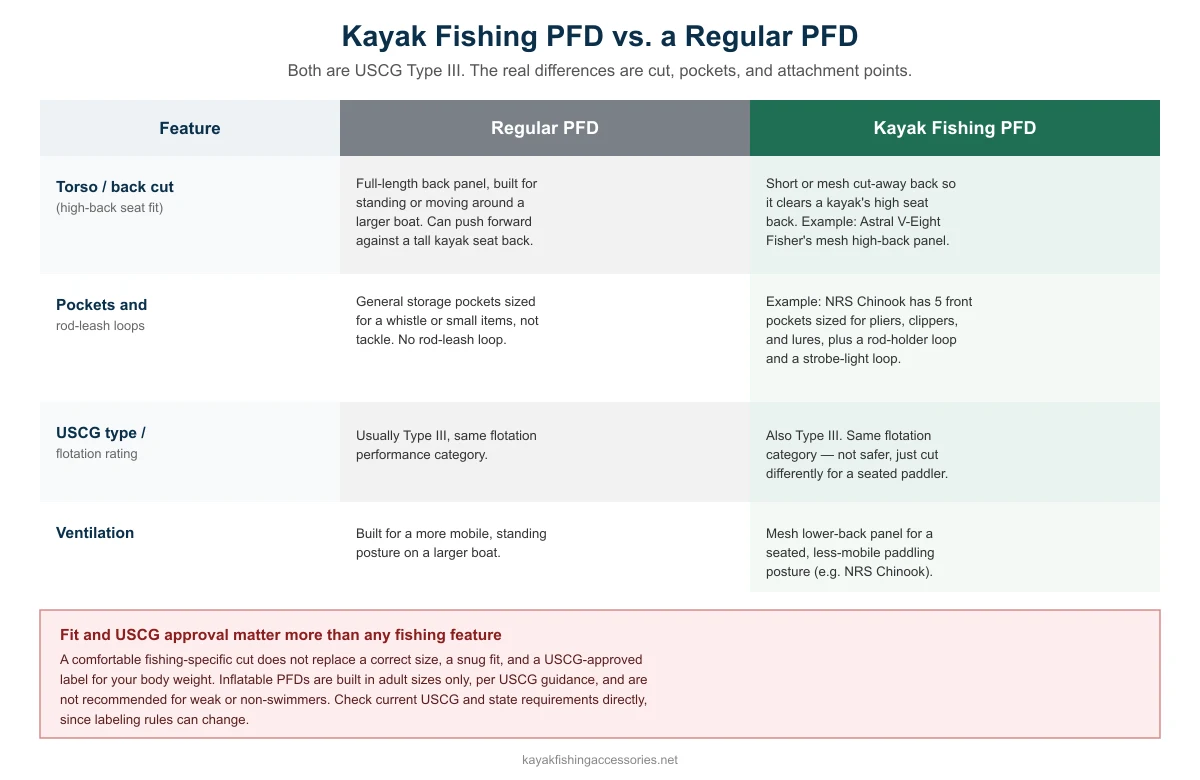
| Feature | Regular PFD | Kayak Fishing PFD |
|---|---|---|
| Torso / back cut | Full-length back panel, built for standing or moving around a larger boat. Can push forward uncomfortably against a tall kayak seat back. | Short or mesh cut-away back so it clears a kayak’s high seat back. The Astral V-Eight Fisher’s manufacturer page states the mesh high-back design exists specifically so it doesn’t interfere with a tall kayak seat. |
| Pockets and rod-leash loops | General storage pockets sized for a whistle or small items, no fishing-specific attachment points. | The NRS Chinook Fishing PFD has 5 front pockets (2 zippered tackle-sized, 2 smaller hook-and-loop, 1 tool holder), plus a rod-holder loop and a strobe-light loop. |
| USCG type / flotation rating | Usually Type III. | Also Type III for both named examples above — same flotation performance category, not a different or better one. |
| Ventilation for seated paddling | Built more for a mobile, standing posture. | The NRS Chinook uses a mesh lower-back panel specifically for ventilation during a seated, less-mobile paddling posture. |
Two current products illustrate the pattern. The NRS Chinook Fishing PFD is USCG Type III with 16.0 lbs of flotation, a high-back design with a mesh lower-back panel, 5 front pockets, a rod-holder loop, and a strobe-holder loop. The Astral V-Eight Fisher is also USCG Type III with 16 lbs of buoyancy, a high mesh back the manufacturer explicitly says is designed not to interfere with a tall kayak seat, and pockets and attachment points sized for fishing gear. Both are named here as sourced illustrations of the pattern, not as “best PFD” endorsements.
Does High-Back Seat Compatibility Really Matter That Much?
If you’ve ever worn a full-back PFD while leaning back against a kayak’s molded or raised seat back, you’ve likely felt the collar push up toward your neck or the jacket ride up uncomfortably. That’s the full-length back panel meeting a seat back it wasn’t designed around. A mesh or cut-away high-back panel is cut short enough to sit above or clear the top of a typical kayak seat, so it doesn’t get pushed or bunched.
This is a comfort-and-wearability factor, not a safety-performance factor. A PFD you find uncomfortable is a PFD you’re more likely to loosen, unzip, or eventually stop wearing consistently — which is the real safety risk. The high-back cut exists to keep you wearing the thing, not to make it float better.

What Should You Know About Inflatable PFDs Before Choosing One?
Inflatable PFDs are lighter and less bulky than foam models, which appeals to anglers who want freedom of movement while casting. But they come with real limitations worth knowing before you buy one for kayak fishing specifically.
Per the U.S. Coast Guard’s own life-jacket-wear guidance, inflatable PFDs are built in adult sizes only — there are no youth, child, or infant inflatable sizes. The same guidance states inflatables are not recommended for weak or non-swimmers, and they depend on a correctly charged, maintained CO2 cylinder with a visible “green” ready indicator, which means ongoing maintenance a foam PFD simply doesn’t need. By contrast, inherently buoyant foam PFDs are available in adult, youth, child, and infant sizes, work for swimmers and non-swimmers, and provide buoyancy at all times without any action required from the wearer.
You may see a specific weight or age cutoff (such as a minimum body weight or age) quoted for inflatable PFDs on retailer or product pages. Always check the exact figure printed on the label of the specific PFD you’re buying and confirm it against current U.S. Coast Guard or state boating-safety guidance before relying on it, since this detail can vary by product and labeling rules can be updated.
What Else Should You Check Before You Buy?
- USCG approval and type come first. Confirm the type rating on the label matches what your state or waterway requires, regardless of how the PFD is marketed.
- Fit matters more than features. A PFD sized for your body weight and adjusted snugly will outperform a feature-loaded PFD that’s too loose or too tight.
- Check the PFD’s condition, not just its specs. Worn straps, a torn shell, or a depleted inflator cylinder on an inflatable model can all compromise performance regardless of type rating.
- Re-check current requirements. USCG and state labeling and carriage requirements are updated periodically — confirm the current rules for your state and waterway before you rely on any PFD.
Once you’ve settled on the right PFD type and fit, think about what else needs to stay with you if you capsize. Our guide to paddle leashes for kayak fishing covers a related safety decision: when keeping your paddle tethered helps, and the specific conditions where a leash becomes a hazard instead.
For the full buying-order framework across all your kayak fishing accessories, see our kayak fishing accessories buying guide.
Frequently Asked Questions
Is a kayak fishing PFD safer than a regular PFD?
No. Both are typically the same USCG Type III classification with the same required flotation performance. A kayak fishing PFD’s differences are in cut, pockets, and ventilation for a seated paddler — not in flotation safety.
Why do kayak fishing PFDs have a mesh or short back?
So the PFD doesn’t push against a kayak’s tall seat back. Astral’s V-Eight Fisher product page states this directly as the reason for its mesh high-back design — it’s a comfort and wearability feature, not a flotation feature.
Can anyone wear an inflatable PFD while kayak fishing?
Inflatable PFDs are built in adult sizes only, per U.S. Coast Guard guidance, and are not recommended for weak or non-swimmers. They also require a correctly maintained, charged CO2 cylinder to work. Confirm the exact weight and fit requirements on your specific PFD’s label before relying on it.
What USCG type should a kayak fishing PFD be?
Most kayak fishing PFDs, including the NRS Chinook and Astral V-Eight Fisher, are USCG Type III, meaning they’re designed to support a conscious wearer in an upright position. Confirm the type on your specific PFD’s label matches what your waterway requires.
Do fishing-specific pockets on a PFD replace a separate tackle bag?
Not fully. PFD pockets are sized for small tools like pliers, clippers, and a few lures you need within quick reach, not for a full tackle supply. For bulk tackle storage, compare a dedicated tackle crate or tackle bag sized to your kayak’s tank well.
Sources
- U.S. Coast Guard, Life Jacket Wear — Wearing Your Life Jacket (PFD types, inflatable sizing and maintenance guidance)
- NRS, Chinook Fishing PFD (product specifications)
- Astral Designs, V-Eight Fisher PFD (product specifications, high-back design rationale)
By kayakfishingaccessories.net Editorial Team. Last updated: November 13, 2026.