Use a paddle leash on calm or sheltered water and in open, windy conditions where a dropped paddle could blow away — but never in moving current, tidal flow, or anywhere with boat traffic, where a leash becomes an entanglement hazard. The situation you fish in, not personal preference, should decide this.
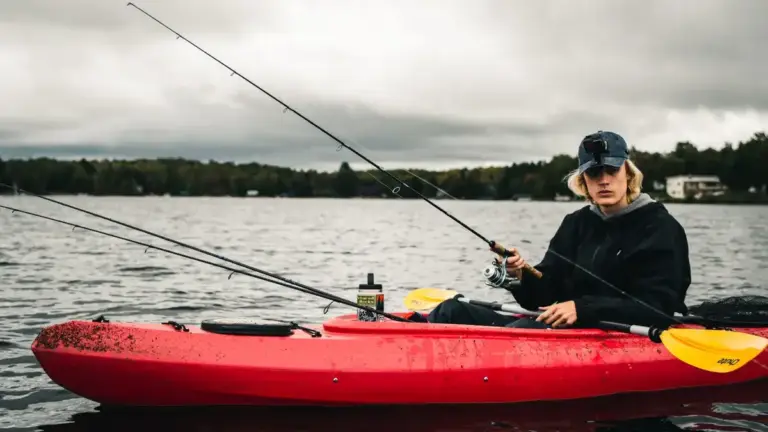
- A paddle leash is reasonable on calm lakes and in open, windy water where a dropped paddle could drift or blow out of reach.
- NRS’s own product page states its Coil Paddle Leash “is not intended for use in whitewater applications due to possible entanglement in swift water.”
- Kayak Angler Magazine gives the same warning: a tangled leash in moving current can pin a paddler or block a wet-exit during a capsize.
- A typical coiled paddle leash runs about 18 inches coiled and stretches to roughly 5 feet — long enough to let you paddle freely, short enough to keep the paddle close.
- No source gives an exact wind-speed threshold for “when” to use a leash — judge by whether the wind is strong enough that you could actually lose the paddle from your hands.

What Does a Paddle Leash Actually Do?
A paddle leash is a short tether, usually with a cuff or hook-and-loop wrap on one end and a clip or swivel snap on the other, that connects your paddle to your wrist, your person, or the kayak’s deck rigging. Its job is simple: if you let go of the paddle — because you’re fighting a fish, bracing against a wave, or capsizing — the leash keeps the paddle from drifting away so you’re not stranded without it.
The NRS Coil Paddle Leash is a useful concrete reference: it coils down to about 18 inches, stretches to roughly 5 feet when you reach or paddle, weighs 4.8 oz, and attaches with a hook-and-loop cuff and a swivel snap connector. That stretch range is the whole point — short enough that the paddle can’t drift far, long enough that it doesn’t restrict a normal paddling stroke.
Situational Decision Guide: When Should You Actually Use One?
Instead of treating a paddle leash as something every kayak angler either always or never needs, match your decision to the water you’re actually fishing. This is the single biggest gap in most buying advice: it recommends leashes universally without flagging the conditions where one becomes dangerous instead of helpful.
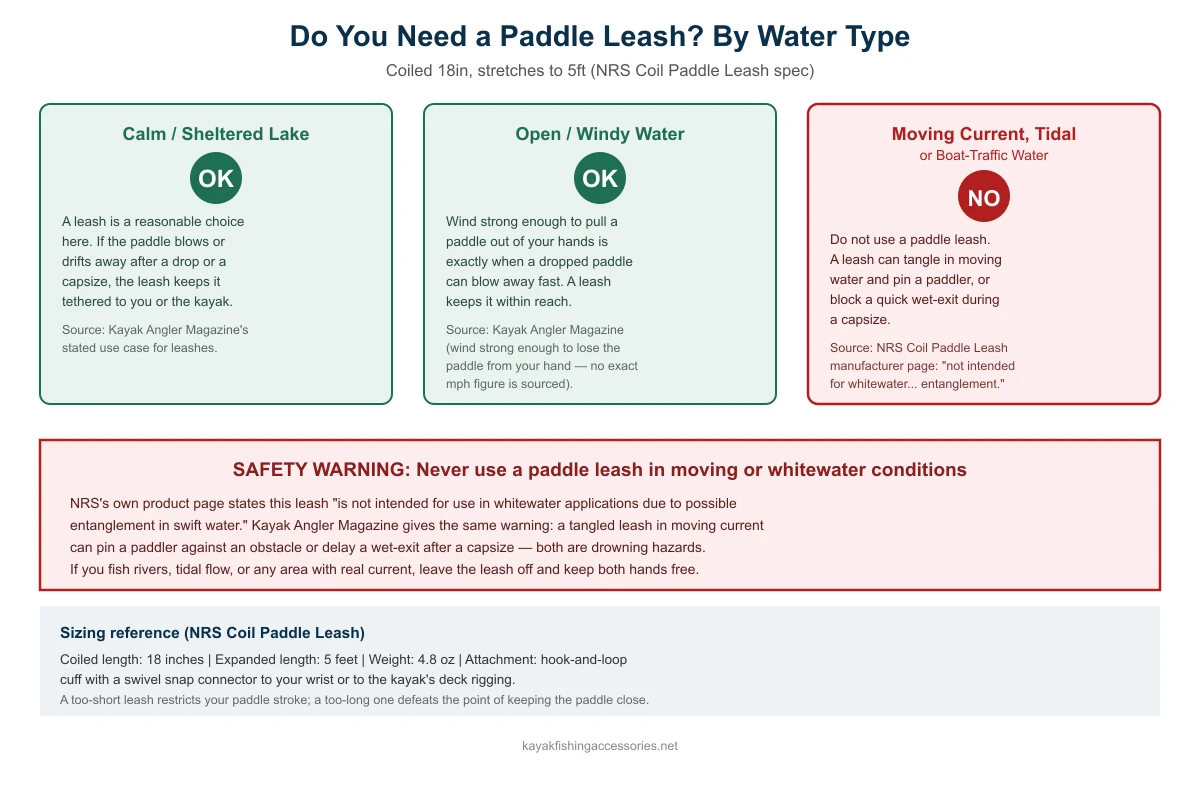
| Water type | Use a leash? | Why |
|---|---|---|
| Calm, sheltered lake | Reasonable to use | Kayak Angler Magazine’s stated use case: if the paddle is dropped or blown away, a leash keeps it tethered instead of drifting off across still water. |
| Open or windy water | Reasonable to use | Wind strong enough to pull a paddle out of your hands is exactly when a dropped paddle can blow out of reach fastest. A leash keeps it within reach. |
| Moving current, tidal flow, or rivers | Do not use | NRS’s own product page warns against whitewater use due to entanglement risk in swift water. A tangled leash can pin a paddler or block a quick wet-exit after a capsize. |
| Water with boat traffic (ICW, channels, busy launches) | Use caution; often skip it | No source gives a specific rule for boat-traffic water, but the same logic that excludes moving current applies anywhere you may need both hands completely free, fast, without fighting a tether. |
Safety Warning: Never Use a Paddle Leash in Moving or Whitewater Conditions
This is the most important point in this entire article, and it’s worth stating plainly rather than as a footnote. NRS’s own Coil Paddle Leash product page states the leash “is not intended for use in whitewater applications due to possible entanglement in swift water.” Kayak Angler Magazine, a trade publication specific to kayak fishing, gives the same caution: paddle leashes and tethers are not for whitewater or rivers with moving current, because a tangled leash in moving water can pin a paddler against an obstacle or block a wet-exit during a capsize.
Both of those are drowning hazards, not inconveniences. A capsize in moving current already demands that you get clear of your kayak and gear quickly. A leash connecting you to a paddle that’s now caught on something, or being pulled by current, works directly against that. If you fish rivers, tidal flow with real current, or any water where you might need to separate from your gear instantly, leave the leash off and rely on keeping a firm grip and a float plan instead.
How Long Should a Paddle Leash Be?
Sizing is simpler than it looks. Using the NRS Coil Paddle Leash as a concrete reference point, a coiled leash that packs down to around 18 inches and stretches to about 5 feet hits the balance most anglers want: short enough that the paddle stays close and doesn’t drag in the water or snag on gear, long enough that it doesn’t yank at your wrist mid-stroke or restrict a normal paddling motion.
A leash that’s too short will fight you every time you reach forward to paddle or cast. One that’s too long defeats the purpose — the paddle can drift far enough to tangle with rod lines, anchor rope, or your own gear on deck before the leash goes taut. If you’re choosing between leash lengths, lean toward the shorter end of what’s comfortable for your paddling reach, not the longest one available.

What Should You Check Before Buying One?
- Confirm the attachment style fits your setup. A hook-and-loop wrist cuff with a swivel snap, like the NRS Coil Paddle Leash, lets you clip to either your wrist or the kayak’s deck rigging depending on preference.
- Match the leash to your usual water, not your best-case day. If you occasionally fish both calm lakes and a tidal river mouth, plan to remove the leash for the current-affected sections rather than leaving it on by default.
- Check the swivel connector periodically. A stiff or corroded swivel can twist the leash into a tangle hazard even on calm water, so inspect it like any other piece of safety gear.
A paddle leash is one piece of a larger on-water safety setup. Before you’re out past where you can easily recover a dropped paddle, make sure your PFD fits correctly and meets USCG requirements — fit and approval matter more to your overall safety than any single accessory.
For the full buying-order framework across all your kayak fishing accessories, see our kayak fishing accessories buying guide.
Frequently Asked Questions
Is a paddle leash necessary for kayak fishing?
Not universally. It’s reasonable on calm lakes and open, windy water where a dropped paddle could drift or blow away. It is not appropriate for moving current, tidal flow, or whitewater, where the entanglement risk outweighs the benefit.
Can a paddle leash be dangerous?
Yes, in the wrong conditions. NRS’s own product guidance and Kayak Angler Magazine both warn that a paddle leash can tangle in moving or swift water, potentially pinning a paddler or blocking a quick wet-exit during a capsize.
How long should a kayak paddle leash be?
A coiled leash around 18 inches that stretches to about 5 feet, like the NRS Coil Paddle Leash, is sized to allow a normal paddling stroke while keeping the paddle from drifting far if dropped. Avoid a leash so long that a dropped paddle can still drift into your lines or gear before going taut.
Should I use a paddle leash in a tidal area?
It depends on whether there’s meaningful current, not just tide-driven water level change. If the tidal area has real moving current, treat it the same as a river: skip the leash. Calm, slow-moving tidal water without strong current is a closer call, but err toward caution.
What’s the difference between a paddle leash and a rod leash?
A paddle leash tethers your paddle to you or your kayak. A rod leash does the same for a fishing rod. They solve a similar problem for different gear, and the same moving-water caution applies to both — a tether on gear you might need to drop instantly in a capsize is a hazard in fast-moving conditions.
Sources
- NRS, Coil Paddle Leash (sizing specifications, whitewater entanglement warning)
- Kayak Angler Magazine, Everything You Need to Know About Fishing Leashes (use-case guidance, moving-water safety caution)
By kayakfishingaccessories.net Editorial Team. Last updated: November 13, 2026.