A tackle crate suits a square or near-square tank well and gives you rigid, upright rod-holder support; a tackle bag suits an oddly shaped or tight well and packs flatter when you’re not fishing. Match your tank-well size, climate, and whether you want built-in rod holders to the table below before you buy.
- A crate’s fixed footprint fits 13x13in and 16x16in wells cleanly; a bag’s soft sides flex into narrower or oddly shaped wells.
- Rigid crate walls can hold rod holders upright on deck; soft bag sides cannot support a rod holder on their own.
- Saltwater anglers need to rinse either option — metal hardware on a crate, and fabric and zippers on a bag — but the failure points differ.
- A repurposed milk crate is roughly the same footprint as a 13x13in dedicated crate, not a separate size category.
- Check YakAttack’s current product page for any specific crate dimension before you buy — sizes and specs do change.
What’s the Real Difference Between a Tackle Crate and a Tackle Bag?
A tackle crate is a rigid, molded-plastic box, usually with slots or mounts for rods and sometimes gear tracks on the sides. A tackle bag is soft-sided, with zippered pockets and often a padded, foldable base. Both sit in your kayak’s tank well — the open storage area behind the seat — but they behave differently once they’re there.
The crate’s rigid walls hold their shape whether loaded or empty, which is what lets it support an upright rod holder. The bag’s soft sides compress to fit a tighter or oddly shaped space, and fold flat for storage when you’re not using it. Neither is “better” in general — the right pick depends on your tank well’s size, your climate, and whether you want extra rod holders on deck.
Decision Table: Crate or Bag by Tank-Well Size and Climate
Instead of a flat pro/con list, match your own tank well and conditions to the table below.
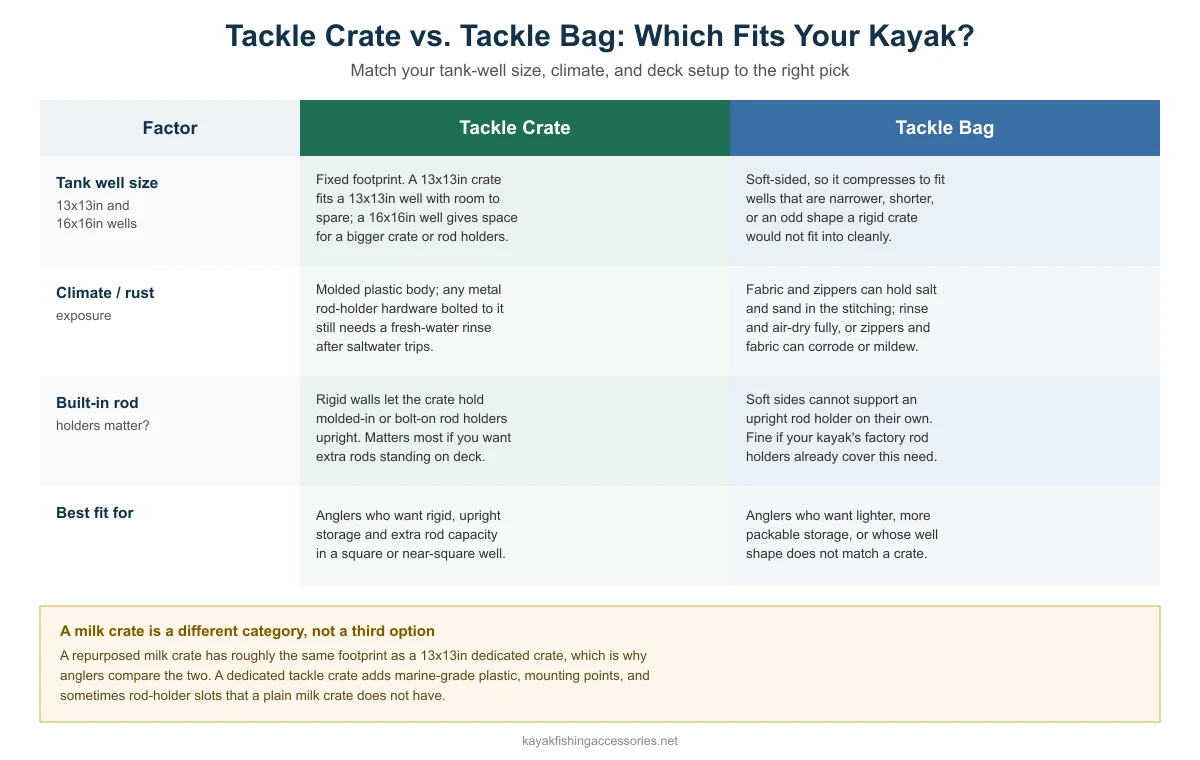
| Factor | Tackle Crate | Tackle Bag |
|---|---|---|
| Tank-well size (13x13in vs. 16x16in wells) | Fixed footprint. YakAttack’s BlackPak Pro ships in a 13x13in size (internal 11.9in x 11.9in x 11.75in) and a 16x16in size (internal 14.9in x 14.9in x 11.75in), so you buy the crate that matches your well, not the other way around. | Soft sides compress to fit wells that are narrower, shorter, or an irregular shape that a rigid crate’s fixed corners would not slide into cleanly. |
| Climate / saltwater exposure | The crate body itself is molded plastic and does not corrode, but any metal rod-holder hardware bolted to it still needs a fresh-water rinse after saltwater trips to avoid rust. | Fabric and zipper teeth can hold salt and sand in the stitching. Rinse and fully air-dry after saltwater use, or the zipper and fabric can corrode or mildew over time. |
| Do built-in rod holders matter to you? | Rigid walls let a crate hold molded-in or bolt-on rod holders upright under load. This matters most if you want extra rod capacity beyond your kayak’s factory holders. | Soft sides cannot support an upright rod holder on their own. This is a non-issue if your kayak’s factory rod holders already cover what you need. |
| Best fit for | Anglers who want rigid, upright storage and extra rod capacity in a square or near-square tank well. | Anglers who want lighter, more packable storage, or whose tank well shape does not match a standard crate. |
Why Does Tank-Well Size Matter So Much?
Kayak fishing crates aren’t one-size-fits-all, and neither are tank wells. YakAttack’s BlackPak Pro line is a useful reference point because the manufacturer lists exact dimensions for each size. The 13x13in model measures 11.9in x 11.9in x 11.75in inside and 12.94in x 12.94in x 13.3in outside. The 16x16in model measures 14.9in x 14.9in x 11.75in inside and 15.94in x 15.94in x 13.3in outside. The 13x16in model sits between the two, at 11.9in x 14.9in x 11.75in inside and 12.94in x 15.94in x 13.3in outside — wider than the 13×13 on one side, matching the 16×16 on the other.
The takeaway: measure your actual tank well before buying a crate. A crate that’s even an inch too wide won’t drop into the well cleanly, and one that’s too small will shift around under paddling and deck-walking. Specs change between model years, so check the manufacturer’s current page for your exact kayak and crate model before you order.
A tackle bag sidesteps this measuring problem almost entirely. Because the sides compress, a bag rated for a given tank-well size has more tolerance for small mismatches — useful if your kayak’s well is an unusual shape, or if you’re not sure of the exact dimensions yet.
What About a Milk Crate Instead?
A plain repurposed milk crate is a common budget option, and it’s worth naming as its own category rather than lumping it in as a cheaper tackle crate. A milk crate has roughly the same footprint as a 13x13in dedicated tackle crate, which is why anglers often compare the two directly.
The difference is what a dedicated tackle crate adds: marine-grade plastic meant to hold up to UV and saltwater, pre-made mounting points for rod holders or accessory tracks, and sometimes internal dividers sized for tackle trays. A milk crate has none of that built in — it’s just a container. This guide covers the buying decision, not how to modify a milk crate into a rigged setup; if you want to add rod holders or tracks to one, that’s a project for a rigging-focused resource, not a buying checklist.
How Do Rod Holders Factor Into the Choice?
If you already have enough rod holders built into your kayak or mounted separately, this factor matters less. But if you want more rods standing ready on deck than your kayak comes with, a rigid crate is the only one of the two options built to support that load upright. A loaded rod, especially with a reel on it, puts real leverage on whatever it’s sitting in — a soft bag’s fabric sides will simply fold over under that weight instead of holding the rod vertical.
NRS’s own Easy Access Tackle Bag is a useful real-world example of why that gap exists. It’s built from 600-denier polyester with parallel zippers and a hook-and-loop lid, and NRS’s own product listing doesn’t mention a rigid insert, a rod holder sleeve, or a D-ring anywhere in the spec sheet — it’s a straightforward soft pouch, not a rod-holding platform. At about 7 oz, it also weighs a fraction of a rigid crate, which is the trade-off: less weight and bulk, but no built-in way to stand a rod up.
For guidance on how many rod holders you actually need for your fishing style and deck space, see our guide to sizing rod-holder count to your setup — it’s worth reading before you decide whether a rod-holder-equipped crate is worth the extra bulk.
Does Storage Choice Affect Your Fish Finder Setup?
A tackle crate or bag in the tank well doesn’t directly interfere with a transducer mount, but deck space is finite, and a bulky crate can crowd the area where a fish finder’s cabling or mounting arm needs to run. If you’re planning both a crate and a fish finder on the same kayak, check our guide to transducer mount types by hull to confirm your hull and deck layout can fit both comfortably before you commit to a specific crate size.
Frequently Asked Questions
Is a tackle crate or tackle bag better for saltwater kayak fishing?
Neither material is immune to saltwater. A crate’s molded plastic body resists corrosion, but any metal rod-holder hardware on it still needs a fresh-water rinse. A bag’s fabric and zippers can hold salt in the stitching and need a full rinse and dry to avoid corrosion or mildew. Whichever you choose, rinse it after every saltwater trip.
Can I fit a 16x16in crate in a 13x13in tank well?
No. A rigid crate’s footprint is fixed, so a 16x16in crate will not drop cleanly into a smaller well. Measure your tank well before ordering, and check the manufacturer’s current size chart, since dimensions can change between model years.
Is a milk crate as good as a dedicated tackle crate?
A milk crate has roughly the same footprint as a 13x13in dedicated crate, but it lacks the marine-grade plastic, built-in mounting points, and dividers that a dedicated kayak tackle crate is designed with. It’s a workable budget starting point, not a direct equivalent.
Do tackle bags work with built-in kayak rod holders?
Yes. A tackle bag’s lack of rod-holder support only matters if you’re relying on the storage container itself to hold rods upright. If your kayak already has enough built-in rod holders for your fishing style, a bag’s soft sides are not a drawback.
How do I know if my tank well fits a 13x16in crate?
Measure your tank well’s exact width and length first, then compare against the manufacturer’s current listed dimensions for that specific crate model — a 13x16in crate is wider on one side than a 13x13in model and should not be assumed identical. Re-check the manufacturer’s page directly, since listed dimensions occasionally need confirming against the live product page.
Sources
- YakAttack, BlackPak Pro 13×13 Kayak Fishing Crate (dimensions)
- YakAttack, BlackPak Pro 13×16 Kayak Fishing Crate (dimensions)
- YakAttack, BlackPak Pro 16×16 Kayak Fishing Crate (dimensions)
- NRS, Easy Access Tackle Bag (manufacturer product page) — material, weight, and construction details for a dedicated soft-sided tackle bag, used to support the no-rod-holder-support comparison
By kayakfishingaccessories.net Editorial Team. Last updated: November 13, 2026.








One thought on “Tackle Crate vs Tackle Bag: Which Fits Your Kayak Setup?”