Your kayak’s hull type decides which fish finder transducer mounts are even possible before you compare any specific product. Scupper mounts suit sit-on-top kayaks with scupper holes, clamp-on arm mounts work on almost any hull, and through-hull or in-hull mounts depend on hull material and whether you’re willing to drill.
Key takeaways
- There are four broad transducer mounting approaches used across kayak fishing: scupper, through-hull, clamp-on arm, and in-hull.
- Sit-on-top kayaks with scupper holes have the most options; inflatable kayaks have the fewest.
- A clamp-on arm mount is the one option that works on nearly every hull type, which is why it’s the default choice when nothing else fits.
- RAM Mounts makes fish-finder-compatible hardware for Garmin, Lowrance, Raymarine, and Humminbird units via track-mounted adapter plates.
- This guide stops at which mount type is physically possible for your hull — it does not cover drilling, sealing, or wiring steps.
What are the four transducer mounting approaches?
Across kayak fishing gear, transducer mounting breaks down into four standard categories, used consistently enough across manufacturers that this is common industry terminology rather than a single brand’s invention:
- Scupper mount: a pole or bracket that drops into one of the kayak’s existing scupper holes, holding the transducer in the water alongside the hull with no drilling required.
- Through-hull mount: a hole drilled through the hull itself, used for permanent installations and for transducer types like side-scan that need a clean signal path.
- Clamp-on arm mount: a bracket similar to a trolling-motor arm mount, clamped to the hull or a track and holding the transducer in the water beside the kayak without drilling.
- In-hull mount: the transducer sits against the inside of the hull, and the signal passes through the hull material itself. This only works on certain hull materials and thicknesses, with no drilling at all.

Which mounts are possible for your hull type?
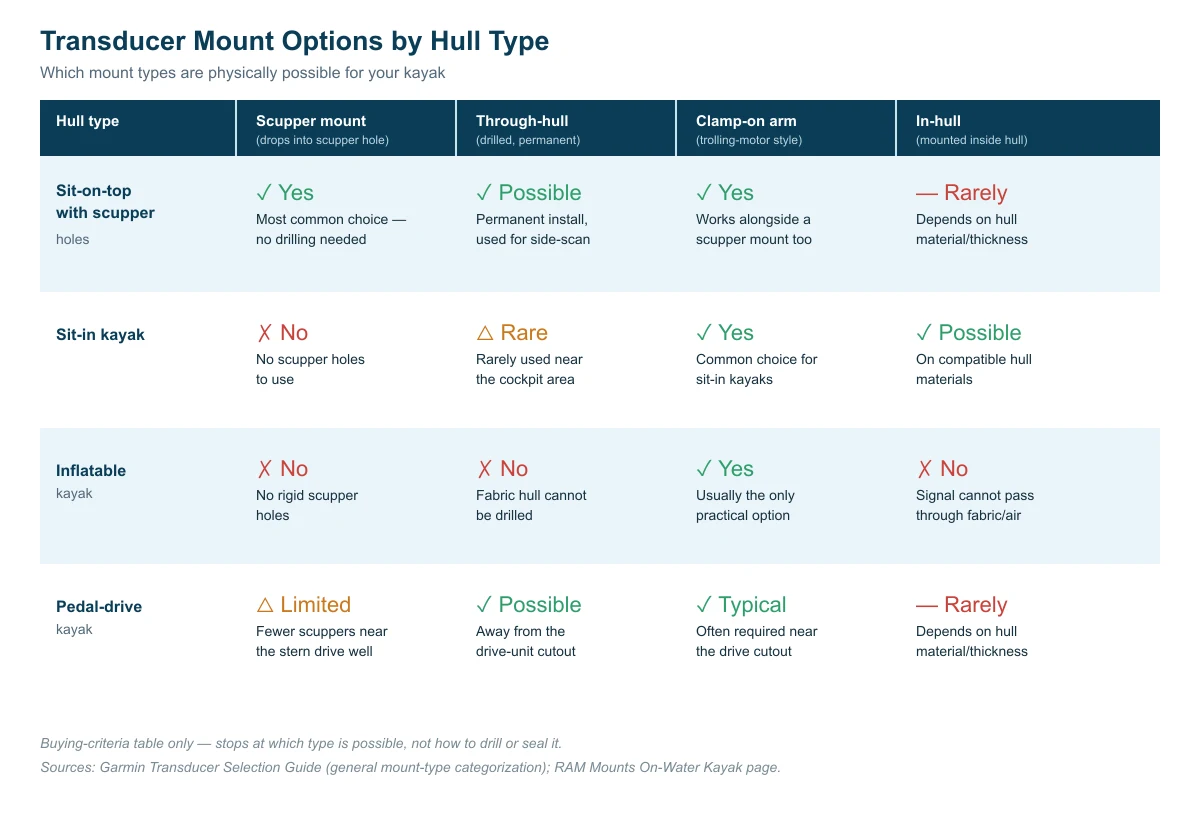
This is the buying-criteria question that actually matters: not which mount is “best,” but which ones are even on the table for the kayak you already own or are about to buy. The table below stops at that question — it does not cover how to drill or seal a through-hull mount, which is a separate, more involved job.
| Hull type | Scupper mount | Through-hull | Clamp-on arm | In-hull |
|---|---|---|---|---|
| Sit-on-top with scupper holes | Yes — most common, no drilling | Possible — permanent, used for side-scan | Yes — works alongside a scupper mount too | Rarely — depends on hull material/thickness |
| Sit-in kayak | No — no scupper holes to use | Rare — rarely used near the cockpit area | Yes — common choice for sit-in kayaks | Possible — on compatible hull materials |
| Inflatable kayak | No — no rigid scupper holes | No — fabric hull cannot be drilled | Yes — usually the only practical option | No — signal cannot pass through fabric/air |
| Pedal-drive kayak | Limited — fewer scuppers near the stern drive well | Possible — away from the drive-unit cutout | Typical — often required near the drive cutout | Rarely — depends on hull material/thickness |
Why do pedal-drive kayaks limit scupper mounting?
A pedal-drive kayak has a cutout in the hull near the stern to house the pedal-driven propulsion unit, which takes up space that would otherwise have scupper holes. That’s why clamp-on arm mounts show up so often on pedal-drive kayaks: there’s often simply less scupper real estate near the stern to work with, and an arm mount clamped further forward, away from the drive unit, sidesteps the problem entirely.
What if I want to mount a fish finder display, not just the transducer?
The transducer is the underwater sensor; the display unit itself usually mounts separately, on the deck or dash area rather than in the water. RAM Mounts, a manufacturer widely used for kayak accessory mounting, offers Track Ball mounts compatible with Garmin, Lowrance, Raymarine, and Humminbird fish finder displays, using adapter plates that clamp into a kayak’s accessory track. These use a composite ball-and-socket design so you can adjust the viewing angle once mounted. RAM’s own page doesn’t list a specific weight-capacity figure for the fish-finder-specific mounts, so don’t expect an exact number here — check the current product listing for your specific display’s weight before buying.
Scupper or clamp-on arm: how do I choose between the two on a sit-on-top?
When both are possible, as they usually are on a sit-on-top kayak with scupper holes, the choice comes down to a few practical buying factors rather than one being universally better. A scupper mount tucks the transducer pole into an existing hole, so it adds very little to the kayak’s width and is less likely to catch on docks, weeds, or your paddle stroke. A clamp-on arm mount sits further out from the hull, which some anglers prefer because it’s easier to swap between kayaks or remove entirely when not fishing, but that extra reach is also one more thing to catch a line on while casting or landing a fish.
If you fish from more than one kayak, or rent occasionally, the clamp-on arm’s portability is the bigger factor. If you fish the same kayak every time and want the lowest-profile setup, the scupper mount usually wins. Either way, measure your kayak’s scupper holes and your transducer pole’s diameter before buying — scupper mounts are not universally sized, and a pole that’s too loose or too tight for your specific holes defeats the purpose.
Should I buy a through-hull mount if my kayak allows it?
Only if you’ve decided you want a permanent installation and the transducer type you’re choosing benefits from it — side-scan transducers are a common reason anglers go this route. If you’re not sure yet, a scupper mount or clamp-on arm mount gets you fishing with electronics without committing to a hole in your hull, and you can switch to a through-hull mount later if you decide the upgrade is worth it. This article covers that buying decision only; the actual drilling and sealing process is a separate job with its own safety and warranty considerations.
Once you’ve picked a mount type, the rest of your electronics setup — where to stash the display’s wiring, battery, and any cables — usually shares space with your other kayak storage. See Tackle Crate vs Tackle Bag for Kayak Fishing: Which Fits Your Setup for how to think about that storage space, and the kayak fishing accessories buying guide for where a fish finder fits into your overall accessory purchase order.
Frequently asked questions
Can I use more than one mount type on the same kayak?
Yes. A scupper mount and a clamp-on arm mount can coexist on the same sit-on-top kayak, for example if you want a backup position or want to compare transducer placement before committing to a permanent through-hull install.
Does an inflatable kayak really have no transducer mounting options?
It has one practical option: a clamp-on arm mount. Through-hull and in-hull mounts both require a rigid hull material that can be drilled or that a signal can pass through, which an inflatable hull doesn’t offer.
Will drilling a through-hull mount void my kayak’s warranty?
This varies by manufacturer, so check your specific kayak’s warranty terms before drilling. This article covers which mount types are possible for your hull, not the installation itself.
What frequency or depth rating do I need for my transducer?
That depends on your specific fish finder display and the water you fish, and it’s a different question from which mount type fits your hull. Check your display manufacturer’s own compatibility documentation for frequency and depth specifications for your model.
Do scupper mounts work on every sit-on-top kayak?
Only if the kayak has scupper holes sized to fit the mount, which varies by model. Measure your kayak’s scupper holes before buying a scupper-mount transducer pole.
Sources
- Garmin, Transducer Selection Guide (manufacturer document) — general mount-type categorization referenced above.
- RAM Mounts, On-Water Kayak (manufacturer product page) — Track Ball mount compatibility and ball-and-socket design details.
kayakfishingaccessories.net Editorial Team. Last updated: November 13, 2026.