Flush mount rod holders sit recessed into the kayak deck at a fixed angle; adjustable post-mount holders sit on a raised base that rotates 360° and tilts. Choose flush mount for a low-profile deck and trolling or bait-soaking; choose adjustable for active casting where you need to aim and re-aim the rod often.
Key takeaways
- The core difference is structural: flush mount is a tube recessed into the deck itself, while adjustable post-mount sits on a raised base above the deck.
- Adjustable holders rotate 360° and tilt via a star knob. Most flush-mount tubes are fixed once installed, but a few flush-base designs, like RAM Mounts’ RAM-301-FU, add a ratcheting tilt even though the base plate itself is flush with the deck.
- Adjustable post-mount holders typically include a front locking ring that flips over the rod blank to stop it bouncing free — a feature specific to that design.
- Flush mount sits lower and clears the deck better, which matters on a kayak with limited open space.
- This article covers which type to buy, not how to install either one — drilling a flush mount into a hull is a separate, more involved job.
What’s structurally different between the two designs?
A flush-mount rod holder is a tube that sits recessed into the kayak’s deck, so the rod stands at a fixed angle set by how the tube was installed. An adjustable post-mount rod holder instead attaches to a base that bolts onto the top or side of the gunnel, and the rod holder itself sits up on a post above the deck surface.
Scotty’s own product line illustrates the difference clearly: the company’s 230 Powerlock is the adjustable post-mount design, paired with a side or deck mount base (model 241) that bolts to the gunnel. The 231 is the flush-mount variant of the same rod holder, paired with a flush deck mount (model 244) that lets the tube sit recessed into the deck instead of raised on a post. Both versions are made from the same fiber-reinforced, engineering-grade nylon, so the material isn’t the deciding factor — the mounting geometry is.
Brands don’t all define “flush mount” the same way, though. RAM Mounts’ Tube Fishing Rod Holder with Flush Base (RAM-301-FU) pairs a flush-mounted base plate — bolted flat against the deck — with a 6-inch post and a ratcheting mechanism that tilts the tube forward and back for different casting angles. That’s a different design than Scotty’s 231, where the tube itself recesses into the deck with no post and no tilt once it’s installed. When you’re comparing “flush mount” rod holders across brands, check whether it’s the base plate that’s flush while the tube still rides on a post, or whether the tube itself is what’s recessed — the term doesn’t always describe the same mechanical design.

Side-by-side: flush mount vs. adjustable post mount
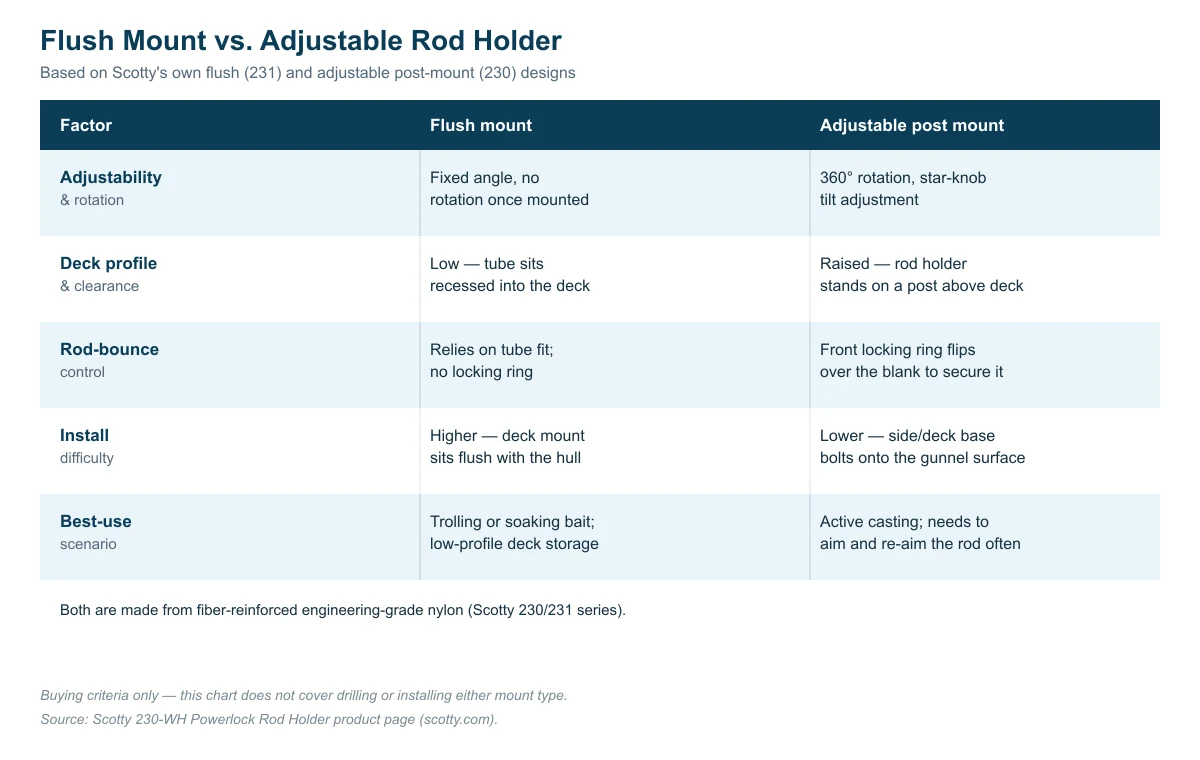
The table below is built from the structural differences between Scotty’s flush (231) and adjustable (230) rod holder lines, not from forum opinions. Any specific claim about water intrusion into either design should be treated with caution — no manufacturer source we checked addresses that directly for either type, so this guide doesn’t make that claim either way.
| Factor | Flush mount | Adjustable post mount |
|---|---|---|
| Adjustability & rotation | Fixed angle, no rotation once mounted | 360° rotation, star-knob tilt adjustment |
| Deck profile & clearance | Low — tube sits recessed into the deck | Raised — rod holder stands on a post above the deck |
| Rod-bounce control | Relies on tube fit; no locking ring | Front locking ring flips over the blank to secure it |
| Install difficulty (buying consideration) | Higher — the deck mount needs to sit flush with the hull | Lower — the side/deck base bolts onto the existing gunnel surface |
| Best-use scenario | Trolling or soaking bait; low-profile deck storage | Active casting; needs to aim and re-aim the rod often |
Why does deck clearance matter so much on a kayak?
A fishing kayak has a fraction of the open deck space of even a small boat. Every raised object is something you can snag a line on, bump a shin against, or trip over while standing to cast. A flush mount keeps the rod holder’s profile at deck level, which is the main reason anglers choose it for secondary rod positions — holders meant to carry a rod while it’s not actively being fished, such as a trolling setup or a spare rod rigged and ready.
An adjustable post-mount holder takes up more vertical space but earns it back in flexibility: you can rotate the rod out of the way while paddling, then swing it back to a fishing angle without leaving your seat. That trade-off — a little more clutter for a lot more control — is why many anglers run a mix of both types rather than committing to one.

Does the locking ring on adjustable holders actually matter?
Yes, if you fish techniques where the rod sits unattended for stretches — trolling, or a dead-sticked bait while you work a second rod. Scotty’s adjustable 230 model includes a front locking ring that flips over the rod blank specifically to stop the rod from bouncing free in chop or when a fish hits unexpectedly. The flush-mount 231 doesn’t have an equivalent locking feature in Scotty’s own lineup; it relies on how snugly the rod butt fits the tube. If you plan to leave rods rigged and unattended often, that’s a point in favor of adjustable holders for those specific positions, even though flush mounts win on deck clearance.
Can I just buy adjustable holders for everything?
You can, but most anglers end up happier mixing both once they’ve fished a season. A common pattern is one or two adjustable holders near the cockpit for actively fished rods, and one or two flush mounts further back or forward for transport and secondary rods that don’t need to be aimed. See How Many Rod Holders Do You Actually Need on a Fishing Kayak? for how to size the total count to your technique mix and deck space, and the kayak fishing accessories buying guide for where rod holders fit into your overall accessory build order.

Does one type cost more than the other?
Generally, adjustable post-mount holders cost more than flush-mount holders for a comparable rod holder tube, mainly because the adjustable version includes the rotating base, the star-knob tilt mechanism, and the locking ring — moving mechanical parts that a flush mount simply doesn’t need. If you’re equipping several holder positions on a budget, a common approach is to put the adjustable holders where you actually need to aim the rod and fill the remaining positions with flush mounts, rather than buying the same type for every position on the kayak.
Frequently asked questions
Can I mix flush mount and adjustable rod holders on the same kayak?
Yes. Many anglers run adjustable holders for rods they’re actively fishing and flush mounts for transport or secondary rod positions, since the two designs solve different problems rather than competing for the same job.
Which type holds a rod more securely in rough water?
No manufacturer source we checked makes a direct comparison claim here. The adjustable design’s locking ring is built specifically to stop a rod bouncing free, which addresses one aspect of security that the flush design doesn’t have an equivalent feature for — but that’s not the same as a tested “more secure in rough water” claim.
Do flush mount rod holders keep water out of the kayak better?
This is a common claim on gear-listicle sites, but no manufacturer source we reviewed supports it directly for either design. Treat it as unverified rather than a real selling point either way.
Is a flush mount rod holder harder to add later than an adjustable one?
As a buying consideration, yes — a flush mount needs its deck mount to sit flush with the hull, while an adjustable holder’s base bolts onto an existing gunnel surface. This article doesn’t cover the installation steps themselves.
What material are these rod holders usually made from?
Scotty’s 230 and 231 series, which this comparison is based on, both use fiber-reinforced, engineering-grade nylon for the rod holder body. RAM Mounts’ flush-base rod holder tube (RAM-301-FU) uses a different high-strength composite instead, so don’t assume one material applies across brands — check the spec page for your exact model.
Sources
- Scotty, 230-WH Powerlock Rod Holder (manufacturer product page) — adjustable and flush-mount specifications, materials, and mounting base details for both designs covered in this article.
- RAM Mounts, RAM Tube Fishing Rod Holder with Flush Base (RAM-301-FU) (manufacturer product page) — flush-base mounting, post length, material, and ratcheting tilt mechanism, used to show that “flush mount” construction differs by brand.
kayakfishingaccessories.net Editorial Team. Last updated: November 13, 2026.







2 thoughts on “Flush vs Adjustable Rod Holders: Which Do You Need?”