Use a stake-out pole in shallow water with a soft bottom you can physically reach and stake into; use an anchor trolley with an anchor anywhere the pole can’t reach bottom, or where the bottom is too hard to grip. Neither tool has a published depth rating, so the right pick comes down to reach and bottom type, not a specific number of feet.
- A stake-out pole works by physically staking into the bottom, so its own length sets the real limit on how deep it can reach.
- An anchor trolley doesn’t anchor anything by itself — it’s a line-management system that lets you position and angle an anchor from the side of the kayak.
- No manufacturer publishes a maximum usable depth for a stake-out pole like the YakAttack ParkNPole; match it to bottom type and reach instead.
- A hard, rocky, or shell-covered bottom defeats a stake-out pole even in shallow water, because the tip has nothing soft to grip.
- Many kayak anglers end up owning both, since they cover different water rather than competing for the same job.
What Does Each One Actually Do?
A stake-out pole is a straight pole, roughly 6 to 8 feet long, with a foot you push against for leverage and a tip you drive into the bottom. YakAttack’s ParkNPole 7’8″ is a real example: a fiberglass body with 0.845-inch diameter tubing and a foot and tip made of UV-stable, wear-resistant nylon. The manufacturer describes it as built for “fishing in shallow waters” — it’s meant to pin the kayak in place by physically touching bottom, not to float an anchor anywhere nearby.
An anchor trolley is a different kind of tool entirely. It’s a loop of cord that runs along the kayak’s side rail through pulleys, with a clamp you can slide and lock anywhere along that loop. YakAttack’s LeverLoc Anchor Trolley (AMS-1003) ships with a LeverLoc line clamp, two Stealth Pulleys, 35 feet of 550 paracord, an anchor ring, and mounting hardware. The trolley itself doesn’t hold the kayak still — it lets you run your anchor line along the side of the boat and adjust the anchor’s pull angle without turning the whole kayak around. You still need an anchor; the trolley just controls where its line attaches.
That functional difference — one stakes directly into the bottom, the other manages an anchor’s line — is why they solve different problems, not the same one with two designs. For general buying-order guidance across your whole kit, see the kayak fishing accessories buying guide.
Decision Table: Water Depth and Bottom Type
Instead of chasing a specific depth number that no manufacturer publishes, match your situation to the table below using two things you can actually judge standing in your kayak: whether you can reach the bottom, and what that bottom is made of.
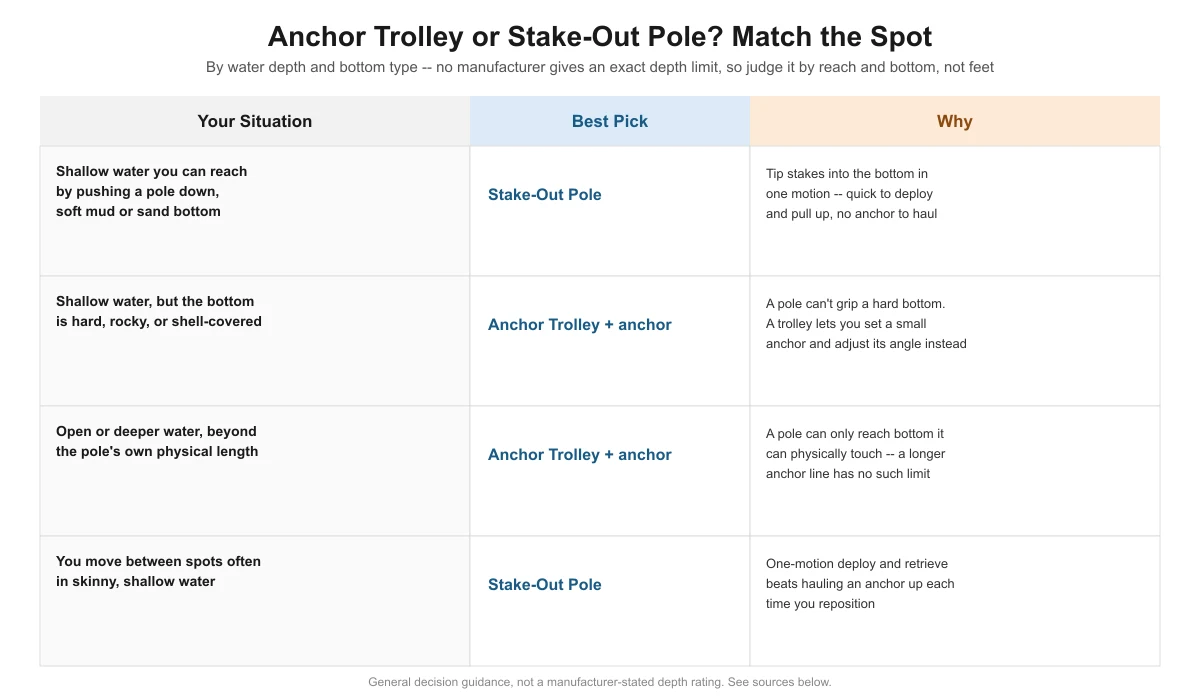
| Your Situation | Best Pick | Why |
|---|---|---|
| Shallow water you can reach by pushing a pole down, soft mud or sand bottom | Stake-Out Pole | The tip stakes into the bottom in one motion. Quick to deploy and pull back up, with no anchor to haul. |
| Shallow water, but the bottom is hard, rocky, or shell-covered | Anchor Trolley + anchor | A pole can’t grip a hard bottom. A trolley lets you set a small anchor and adjust its angle instead. |
| Open or deeper water, beyond the pole’s own physical length | Anchor Trolley + anchor | A pole can only reach bottom it can physically touch. An anchor line on a trolley has no such limit. |
| You move between spots often in skinny, shallow water | Stake-Out Pole | One-motion deploy and retrieve beats hauling an anchor up every time you reposition. |
This table deliberately avoids a specific depth cutoff. A stake-out pole’s maximum reach is simply its own length minus however much needs to stick out above the water for you to push against — a 7-foot-8-inch pole like the ParkNPole can’t help in water much deeper than that, but no manufacturer page states a formal depth rating, and this article isn’t inventing one.
Why a Stake-Out Pole Can’t Reach Every Bottom
A stake-out pole only works where two conditions overlap: the water is shallow enough for the pole to physically touch bottom, and the bottom is soft enough for the tip to bite in and hold. Push it into firm sand or mud and it sticks. Push it against bedrock, packed shell, or a hard clay bottom, and the tip has nothing to grip — it slides or skips instead of staking. This is basic mechanics, not a manufacturer claim, but it explains why some anglers who fish skinny water with a mixed bottom still carry a small anchor as backup.
Open or deeper water removes the first condition entirely. Once the water is deeper than the pole’s working length, there’s no way to reach bottom at all, regardless of what that bottom is made of. That’s the point where an anchor and trolley setup takes over, since an anchor line can be let out to whatever depth the water actually is.
When You Need Both
Anglers who fish a mix of skinny flats and open water on the same trip often end up with both tools rather than choosing one permanently. A stake-out pole stays the faster choice for quick stops in reachable, grippable bottom, while the trolley-and-anchor setup covers everything the pole can’t reach. Neither replaces the other; they cover different parts of the same day on the water. For the related question of whether to add a drift chute to your anchor setup for windy days, see anchor trolley vs. drift chute.
What to Look for When Buying
- Pole material and tubing diameter. Fiberglass poles like the ParkNPole (0.845-inch tubing) flex slightly and resist corrosion better than aluminum in saltwater, which matters most for coastal anglers.
- Foot and tip design. A UV-stable nylon foot and tip resist cracking in sun and repeated staking better than cheaper plastics.
- Trolley line length and pulley count. YakAttack’s LeverLoc kit includes 35 feet of 550 paracord and two Stealth Pulleys — enough line to angle an anchor well out from the kayak’s side.
- Heavier-duty trolley versions. YakAttack also sells an AMS-1004 version with extra backing plates, aimed at anglers who want sturdier hardware for repeated hard use.
- Mounting-track compatibility. Check that the trolley’s pulleys and clamp fit your kayak’s existing accessory track or rail system before buying, so you’re not stuck returning hardware that doesn’t match.
Anchor Selection and Safety
If you pair a trolley with a separate anchor rather than a stake-out pole, size and type matter. The Iowa Department of Natural Resources recommends getting “an appropriately sized anchor,” noting that specialty kayak anchors with a folding “claw” system hold better in current or wind, and that a weight of about 10 pounds or less is enough to lock a kayak in place over a school of fish or a piece of cover. The same agency’s kayak-fishing guidance also recommends tying down loose gear such as your paddle and tackle box, and staying alert for low-head dams and wood-debris strainers wherever current is involved.
Frequently Asked Questions
Can I use a stake-out pole in deep, open water?
No. A stake-out pole only works where it can physically touch bottom and the pole’s own length limits that reach — roughly 6 to 8 feet for common models like the YakAttack ParkNPole. In open or deep water, use an anchor on a trolley instead.
Does an anchor trolley work without an anchor?
No. A trolley is a line-management system, not an anchor itself. It lets you run an anchor’s line along the kayak’s side and adjust the angle, but you still need a separate anchor attached to that line.
Why would I buy a heavier-duty anchor trolley version?
YakAttack’s AMS-1004 trolley adds extra backing plates compared with the standard AMS-1003 kit, which spreads mounting stress over more surface area. That’s worth it if you fish rough water often or want sturdier hardware for frequent hard pulls.
Can a stake-out pole work on a rocky or shell bottom?
Not reliably. The tip needs a bottom soft enough to bite into. A hard, rocky, or shell-covered bottom gives the tip nothing to grip, even in water shallow enough for the pole to reach.
Is it worth owning both a stake-out pole and an anchor trolley?
Yes, for anglers who fish a mix of shallow flats and open or deeper water. Each covers ground the other can’t — the pole for quick, shallow, grippable-bottom stops, and the trolley-and-anchor setup for everything beyond the pole’s reach.
Sources
- YakAttack, ParkNPole 7’8″ product page (material, tubing diameter, intended shallow-water use)
- YakAttack, LeverLoc Anchor Trolley (AMS-1003) product page (kit contents, line length, trolley function, AMS-1004 heavy-duty variant)
- Iowa Department of Natural Resources, Kayak Fishing (anchor type, weight guidance, and general kayak-fishing safety practices)
By kayakfishingaccessories.net Editorial Team. Last updated: November 13, 2026.



One thought on “Anchor Trolley or Stake-Out Pole: Which Does Your Spot Need?”